

Why PC games stutter and consoles mostly don't
Why do PC games stutter more than consoles? Shader compilation, explained through Elden Ring, Jedi: Survivor and Unreal Engine 5, and the fixes that are finally arriving.
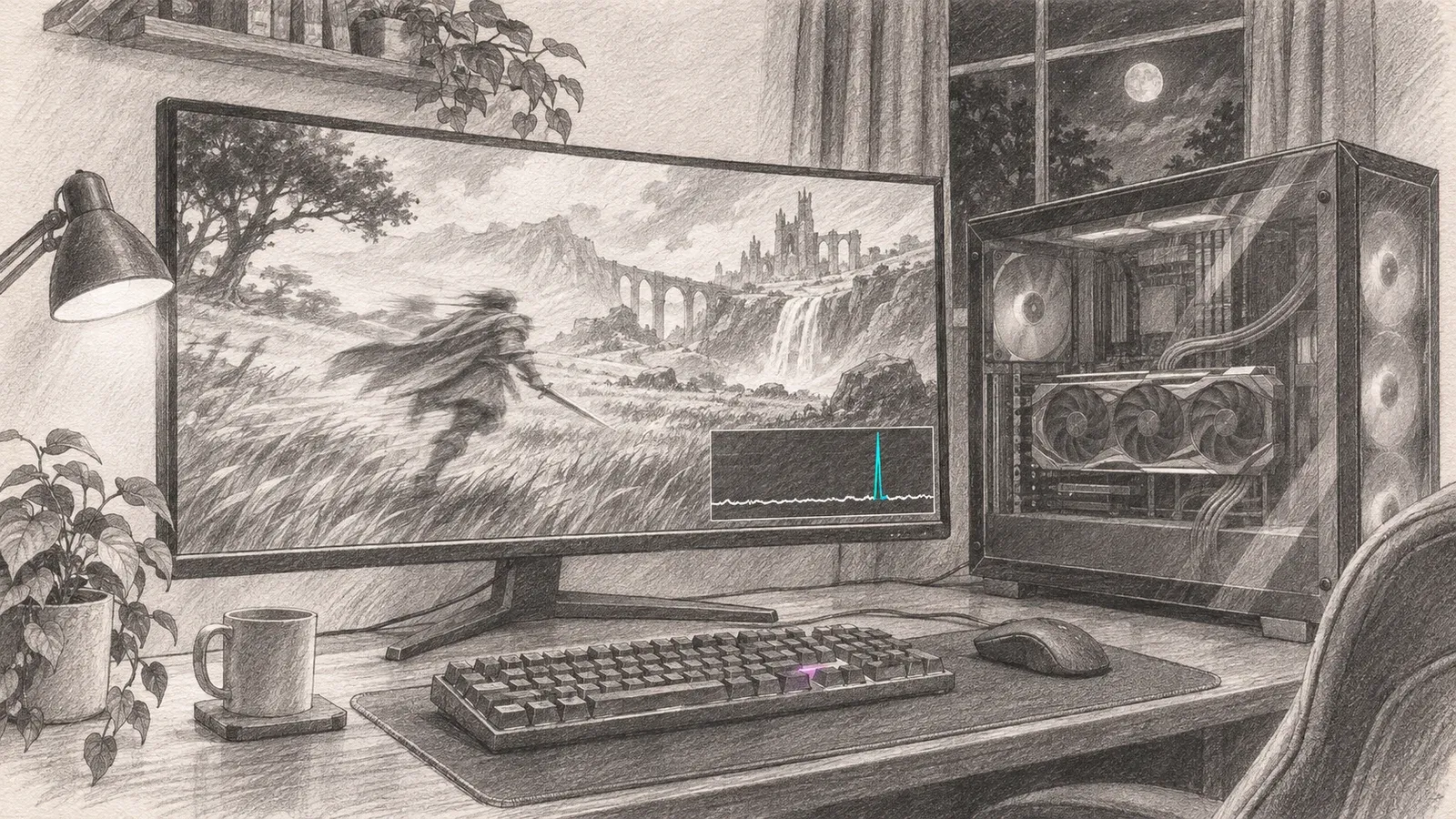
Elden Ring came out on PC on 25 February 2022. The next day Alex Battaglia of Digital Foundry published a list of every moment it froze: “There’s a noticeable stutter when you first move your character. There’s another when you first thrust your sword.” Every new particle effect brought another one, some lasting up to a quarter of a second. The cause has a dull name and an obvious effect: shader compilation stutter.
A program for every effect
A shader is a small program that runs on the graphics card and decides how a surface, a light or a puff of smoke looks. Every console of one model has the same graphics chip, so developers compile their shaders in advance and ship them ready to run. A PC can have any number of graphics cards and driver versions, so the game hands its shaders to the driver, which compiles them for your card on your machine.
If the game does that ahead of time, you wait at a loading screen. If it does not, the work lands in the middle of play. Battaglia described Elden Ring doing exactly that: “every single time a new shader effect is invoked that you may not have seen before, the game tries to compile it ‘just in time’.” Epic Games puts a number on the cost: compiling on demand “can take tens of milliseconds or more for a single draw command, resulting in very long frames.” At 60 frames per second you have about 16 milliseconds per frame, so one compile can swallow several.
The game keeps what it compiled, so the second visit to an area feels smoother. That relief does not last: Digital Foundry found the cache “resets to default every time the game is updated, reinstalled or if the user updates their graphics driver.”
The Unreal problem
Shader stutter is not limited to one engine, but several of the games Digital Foundry criticised for it run on Unreal Engine. In July 2023 Digital Foundry tested Unreal Engine 5.2, which added precaching of the graphics pipeline states that trigger compiles. The worst hitches, around 500 milliseconds, disappeared; smaller ones of 30 to 50 milliseconds remained. Battaglia suggested developers should combine the new system with the older offline precaching rather than rely on either alone.
Some games got better slowly. More than 500 days after Star Wars Jedi: Survivor launched, Digital Foundry still called it “not good enough on PC - not by a long shot.” Its ninth patch, in September 2024, ran the shader step only after game or driver updates, and the first run through one area dropped from more than two dozen shader stutters to four.
Other games showed the problem had more than one cause. Silent Hill 2, in October 2024, had no shader compilation stutter at all, yet Digital Foundry found heavy traversal stutter, the hitch when a game streams in the next part of the world. Battaglia’s verdict: “These are continuing, foundational problems with Unreal Engine that requires a software fix.” Epic’s chief executive, Tim Sweeney, put the blame elsewhere in August 2025: “Many studios build for top-tier hardware first and leave optimisation and low-spec testing for the end.” Both views are on the record. When Borderlands 4 launched that September, Gearbox was telling players that “any time you change any of your graphics settings, your shaders will need to recompile,” and to give the game at least 15 minutes before judging its performance.
Consoles stutter too, just less
Consoles avoid the shader part, not stutter in general. Digital Foundry found Silent Hill 2’s traversal stutter plain to see on the PlayStation 5 in its 30 fps mode. And a flat frame-rate counter does not prove a game runs smoothly: in Jedi: Survivor, Digital Foundry saw camera and animation judder “even when the frame-rate graph reports a perfectly flat 60fps.” That is a frame pacing problem, where frames arrive unevenly even though enough of them arrive.
Shipping the shaders with the game
The fix PC players want is the console one: compiled shaders delivered with the game. Valve tried it early. In December 2017 Steam began downloading precompiled shaders for OpenGL and Vulkan games, “whenever possible, depending on hardware and driver support,” which left out DirectX games on Windows.
At GDC in March 2026 Microsoft described Advanced Shader Delivery, which downloads a database of precompiled shaders along with the game. Its example was Call of Duty: Modern Warfare 4: “With ASD, shader compilation at first launch takes just a few seconds, compared to several minutes on a typical PC without ASD.” Nvidia added support in its 621.01 driver in October 2026. Digital Foundry’s caveat: it does nothing for traversal stutter.
If you play Modern Warfare 4 on a supported PC, a small line of text appears in the corner at launch: “Precompiled shaders installed.” Nearly five years after Elden Ring froze on its first sword swing, PC games are starting to ship their shaders the way console games always have.
Sources
Checked .
- Elden Ring's PC performance simply isn't good enough — Digital Foundry
- Epic talks shop about stuttering in games that use its Unreal Engine and offers solutions to the problem — PC Gamer
- PSO Precaching for Unreal Engine — Epic Games
- Unreal Engine 5.2 features analysed: is this the answer to #StutterStruggle? — Digital Foundry
- Silent Hill 2 on PC: another Unreal Engine 5 game blighted by stutter — Digital Foundry
- Does the big Jedi: Survivor PC patch finally solve the game's performance issues? — Digital Foundry
- Epic CEO blames Unreal Engine 5 issues on developers, but more support incoming — Eurogamer
- Steam Client Update Released — Valve
- Advanced Shader Delivery is available now across hardware — Microsoft DirectX blog
- Shader Compilation Stutter Begone: Nvidia's Latest GPU Drivers Finally Add Advanced Shader Delivery — Digital Foundry